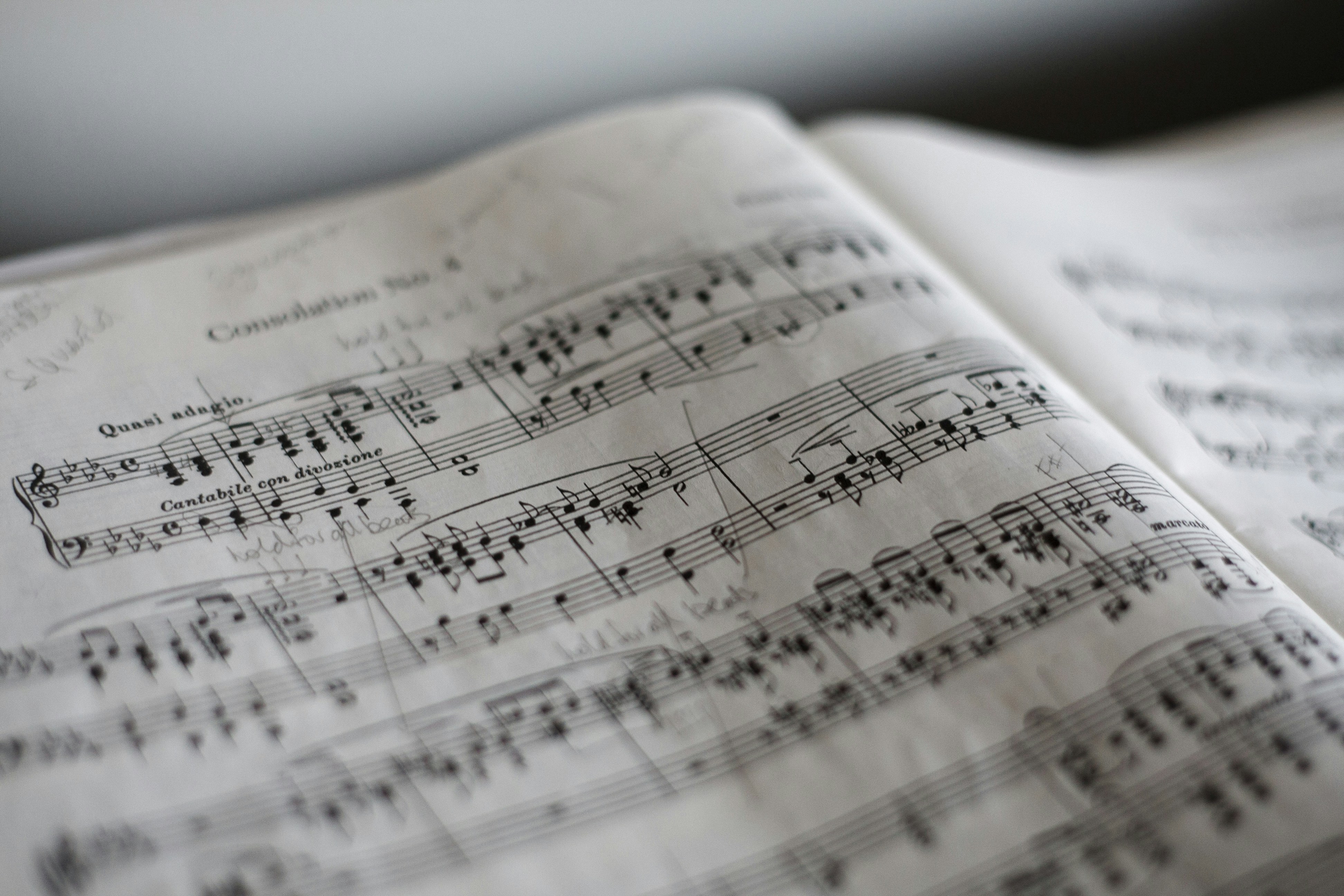
If you are starting your journey with music, sooner or later you will come across the term musical intervals. It may sound serious, but in practice it is something very simple: the distance between two notes. Thanks to understanding intervals, we can better understand melodies, chords, and harmony. They are worth learning because they are useful when reading sheet music, singing, playing an instrument, and during ear training.
What are intervals and why recognize them?
Simply put, an interval is the distance between two notes. It can be small, large, perfect, or altered (diminished/augmented), and its name depends on the number of scale degrees and semitones. You have probably heard names such as unison, second, third, fourth, fifth, sixth, seventh, and octave. Beginners usually start with these basics, because they appear most often in songs, exercises, and simple melodies.
Intervals are also divided into melodic and harmonic. You hear melodic intervals when notes follow one another, and harmonic intervals when they sound at the same time. This is important, because recognizing intervals in a melody works a bit differently than recognizing them in a chord, and both skills are worth practicing separately.
Memorizing melodies
Some intervals are easier to remember through short motifs from well-known melodies. This way, when in doubt, you can compare sounds to your favorite song or a familiar piece. How does recognizing intervals using songs work? It’s simple: to build an interval, just hum the first two notes of a chosen song. When you want to recognize an interval, check if it sounds like the beginning of that piece. It’s very helpful and intuitive.
Below is a table of example melodies that help identify individual intervals.
| Interval | Symbol | Semitones | Ascending melody | Descending melody |
|---|---|---|---|---|
| Perfect unison | P1 | 0 | Can-can from "Orpheus in the Underworld" | |
| Minor second | m2 | 1 | "The Pink Panther" theme | "Für Elise", Ludwig van Beethoven |
| Major second | M2 | 2 | "Happy Birthday" | "Yesterday", the Beatles |
| Minor third | m3 | 3 | "Seven Nation Army", the White Stripes | "Happy Birthday" |
| Major third | M3 | 4 | "Four Seasons: Spring", Vivaldi | Beginning of Beethoven’s 5th Symphony |
| Perfect fourth | P4 | 5 | "We Wish You a Marry Christmas" | "Eine Kleine Nachmusik", Mozart |
| Tritone | T | 6 | "The Simpsons" theme | "Even Flow", Pearl Jam |
| Perfect fifth | P5 | 7 | "Twinkle, Twinkle, Little Star" | "The Flintstones" theme |
| Minor sixth | m6 | 8 | "Requiem, Lacrimosa", Mozart | "Call Me Maybe", Carly Rae Jepsen |
| Major sixth | M6 | 9 | "Dashing through the snow" from "Jingle Bells" | "Sweet Caroline", Neil Diamond |
| Minor seventh | m7 | 10 | "The Winner Takes It All", ABBA | Chorus of "Lady Jane", The Rolling Stones |
| Major seventh | M7 | 11 | "Take On Me", a-ha | "Have Yourself a Merry Little Christmas", Nat King Cole |
| Perfect octave | P8 | 12 | "Somewhere over the Rainbow", Wizard of Oz | "Willow Weep for Me", Ann Ronell |
These are just selected examples from folk, classical, and popular music. Everyone can find their own songs that they know and like best. Association melodies are only a memory aid — there is no single correct set, as different teachers use different examples. The most important thing is to quickly recognize the sound of an interval, not just its name. This strongly supports ear training and working with sheet music.
Counting scale degrees and semitones
If you want to recognize intervals more confidently, learn two things at once: counting scale degrees and counting semitones. The combination of these two pieces of information allows you to distinguish, for example, a minor second from a major second or a minor third from a major third. Fourths, fifths, and octaves are usually perfect intervals, while seconds, thirds, sixths, and sevenths can be either minor or major.
It is also helpful to remember characteristic functions of intervals:
• Unison is repeating the same note
• Minor second is the end of a scale
• Major second is the beginning of a scale
• Minor third starts a minor chord
• Major third starts a major chord
• Perfect fourth relates to tonic and dominant
• Perfect fifth are the outer notes of a triad
• Minor seventh are the outer notes of a seventh chord
• Major seventh is tonic and leading tone
• Octave is the same note higher/lower
Once these associations become natural, it will be easier to recognize more difficult intervals.Recognizing intervals on the staff
Reading sheet music also helps a lot. On the staff, you can quickly see whether notes are close together or separated by a larger leap. This is especially useful for people learning piano, guitar, violin, or singing. The ability to look at notation and immediately understand the interval significantly speeds up learning.
Singing and daily ear training
One of the best ways to recognize intervals is singing. Singing notes as exercises helps connect notation with real sound. Just a few minutes a day is enough: comparing notes, repeating simple patterns, and checking whether the interval you heard was correct.
Training with apps also works very well. Modern ear training tools allow you to practice intervals step by step, from the simplest to more complex ones. Regular practice and gradually increasing difficulty are key. Our free website doremoll works great for this, where you can practice interval recognition intuitively, for free, and without logging in.
How to practice effectively?
Shorter but more frequent practice is best. Instead of long, exhausting sessions, practice a few minutes every day. Start with simple melodic intervals. Then move on to descending, harmonic, and later add more intervals up to the tenth. This gradual approach really works.
Common mistakes
Many beginners confuse minor and major intervals, forget key signatures, or count scale degrees from the wrong note. This is normal. The most important thing is not to guess, but always check: how many degrees, how many semitones, and how the example sounds in practice. It may sound simple, but ear training is like many other skills — it requires practice.
A common mistake is moving on to harder examples too quickly. If you are not yet confident recognizing melodic intervals, practicing harmonic ones will only make things confusing. It is better to build a solid foundation first and only then move forward.
Some people don’t know how to practice at home. They learn about intervals in lessons, then play them on their instrument and try to pretend they recognize them by ear. The solution is very simple — there are many online tools for ear training that are easy to use. On our website, you will find exercises including intervals, chords, scales, keys, notes, rhythm values, and dominants. It is really worth developing these skills.
Why is it worth it?
Understanding intervals helps not only in music lessons. It makes singing easier, helps with playing by ear, understanding chords, transposition, and faster sight-reading. It is one of those skills that truly make a difference in everyday music-making. Musical intervals are the foundation of melody and harmony, so the sooner you master them, the better you will understand music as a whole.
Sources
• INFOGITARA.PL, “Poradnik: Zapis nutowy i interwały”.
• Kwadrans dla Gitary, “Co to interwały?”.
• Wikipedia, “Interval (music)”, "Enharmonic equivalence".
• Konczetracki.pl, “Jak ćwiczyć słuch – metody rozwoju umiejętności muzycznych”